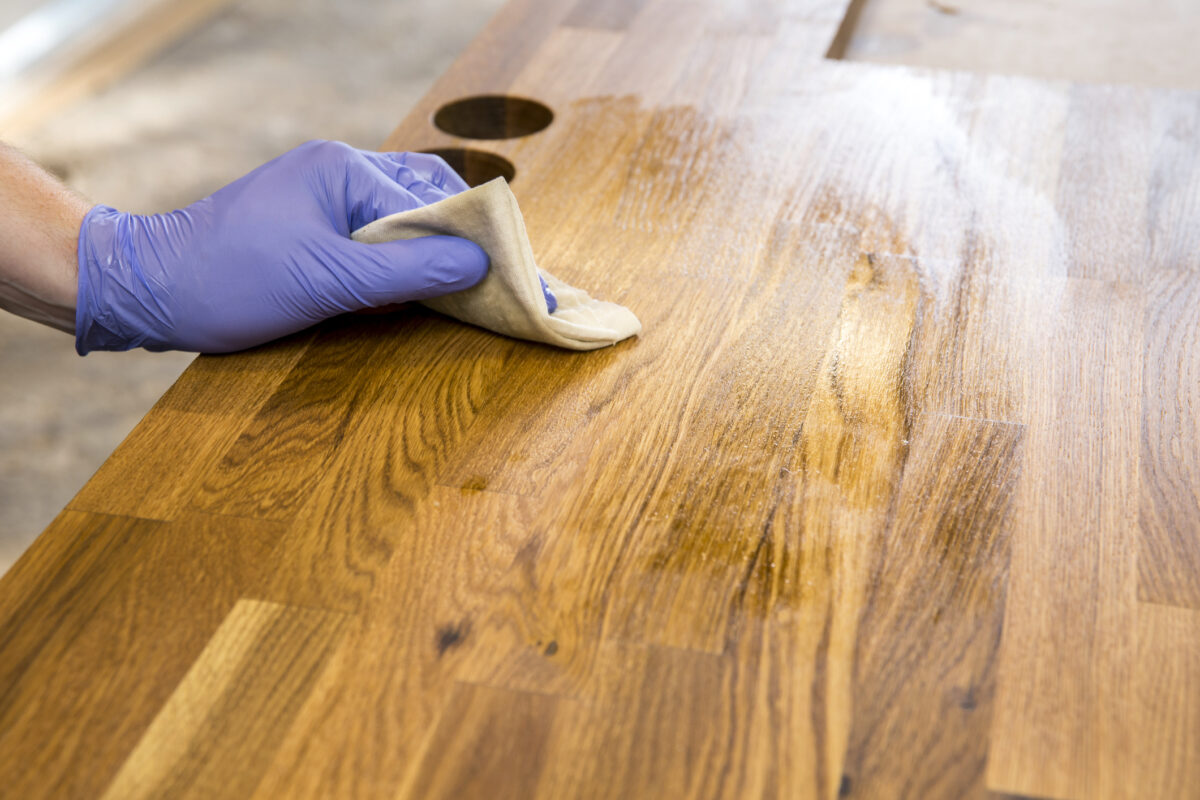
Oil a wooden cutting board only when its producer’s care instructions recommend it. Use the named product or a compatible treatment specifically intended for that type of board and its relevant food-contact use. Apply it to a clean, completely dry surface, follow the product’s stated quantity and waiting time, follow its directions for excess removal and any drying or curing period before the board returns to use.
That condition matters. Dutch Voedingscentrum advises against oiling wooden boards because oil may slow drying and leave a sticky surface. By contrast, producers including Continenta, IKEA and John Boos give oiling instructions for particular products. Those positions should not be blended into one universal rule: first identify your board, its existing finish and its own care guidance.
A new board does not automatically need another coat. Some boards are sold pre-oiled and ready to use, while others instruct the owner to apply a food-contact-suitable oil before first use. The correct answer comes from the instructions for the actual product, not from the word “wooden” on its own.
First Check Whether Your Board Should Be Oiled
Start with the packaging, manual or producer’s product page. You are looking for three facts: what the board is made from, how its surface was supplied, and which maintenance product—if any—the producer specifies.
Treat “unfinished”, “pre-oiled”, “oil-wax”, “hardwax oil”, “lacquered” and “composite” as different care situations. If the instructions describe a factory coating or proprietary finish, do not assume that an absorbent board oil can be added over it. Use the stated maintenance route or ask the producer.
The contrast between specific products is useful. Teakhaus describes one of its boards as pre-oiled and ready to use. IKEA’s FASCINERA instructions instead call for treatment with an oil approved for food contact before use. Even boards that look similar can therefore begin with different requirements.
If you are still choosing a board, Cookholt’s guide to the best wood for cutting boards explains why construction, finish and care information matter alongside the wood name.
How to Choose a Suitable Board-Care Product
A product being edible, plant-based or described as “natural” does not by itself establish that it suits your board. The European Commission’s food-contact guidance explains that materials and articles intended to contact food must meet safety requirements. For a care product, look for a clear manufacturer statement that it is intended for the relevant wooden food-preparation surface, then confirm that it is compatible with the board’s finish.
There are several product types, and their instructions are not interchangeable.
Mineral-oil board products
Some producers specify a purified mineral-oil product for bare or previously oiled wood. For example, Howard describes its Cutting Board Oil as 100% USP food-grade mineral oil and gives different soaking and coating directions for utensils, new boards and thick butcher blocks. These are instructions for that product—not a universal quantity or timetable for every board.
Drying-oil and oil-wax finishes
A drying-oil or oil-wax formulation is used more like a finish than a simple soak-and-wipe oil. Osmo TopOil, for example, is documented for furniture and kitchen worktops; it illustrates a different finish system, not a recommendation for an unidentified chopping board. It contains plant oils, waxes and drying agents. Its instructions require thin coats left in place without wiping, ventilation and a stated drying period; they also warn that product-soaked cloths can self-ignite and specify safe drying and disposal. If your selected product carries a similar warning, follow it exactly.
Do not substitute a bottle of generic linseed, tung or furniture oil merely because the ingredient name resembles a board finish. Formulation, additives, drying behaviour and food-contact instructions can differ.
Oil-and-wax blends
Wax blends may be a second maintenance stage for a compatible board. The John Boos care guide, for example, describes a beeswax-and-food-grade-oil cream applied after its Mystery Oil. That does not mean every board needs wax, or that a wax blend can replace the product named by another producer.
Can You Use Olive Oil or Sunflower Oil?
Do not decide from the word “natural”. Producer guidance varies: IKEA refers to vegetable oil approved for contact with food for some boards, while ZWILLING’s producer guide warns that olive, rapeseed and sunflower oils can become rancid. Because the advice is product-specific, use an ordinary cooking oil only when the instructions for your particular board explicitly permit or name it.
If the instructions simply say “food-safe oil” without identifying a product standard or compatible type, ask the producer for clarification. A product being safe to eat is not the same question as whether it will remain stable and compatible on that surface.
How to Oil a Wooden Cutting Board
Once you have confirmed that oiling is appropriate, use this framework while allowing the board and care-product instructions to control the details.
- Read both sets of instructions. Confirm the product, surfaces to treat, number of coats, application tool, waiting time, ventilation and any cloth-disposal warning.
- Clean the board and let it dry completely. Do not trap washing water beneath a fresh treatment. Cookholt’s guide on how to clean a wooden cutting board covers the washing and drying method without duplicating it here.
- Prepare a clean working area. Use the applicator named on the label, such as a clean lint-free cloth, pad or brush. Keep food away while the product is being applied and dried.
- Apply the stated amount in the stated way. If the producer calls for a thin, even coat following the grain, do that. Treat only the faces, edges or other areas specified; do not invent a universal quantity or flood a board whose instructions call for a light coat.
- Wait for the documented absorption or drying period. Continenta tells users of its wood balm to work it evenly into a clean, dry product and leave it overnight. Other formulations specify different periods, so “overnight” is not a rule for every product.
- Finish the application as the product directs. For a soak-and-wipe board oil, remove excess with a clean cloth after the stated absorption period. Some drying finishes require a thin coat to remain in place, so follow their method instead of adding a wiping stage. Excess product can leave the surface tacky or delay drying.
- Return the board to use only when the instructions allow it. For an absorbent treatment, this may mean the product has been absorbed and all excess removed. A drying finish may require a defined drying or curing period. The surface should not feel oily or sticky, and any label-specific waiting time must be complete.
How Often Should You Oil a Wooden Cutting Board?
There is no reliable schedule for every board. Frequency depends on the particular finish, the product used, washing frequency, household conditions and the producer’s maintenance plan.
Published instructions vary widely. John Boos recommends at least monthly treatment for its boards, adjusted for use and household conditions, and says a dry appearance is a cue. IKEA’s ARTISTISK oak board instead specifies reconditioning at least once or twice a year. These examples are not competing universal rules; each belongs to a named product.
Follow the interval for your board. If the instructions use condition rather than a calendar, look for the cue they name—such as a dry or dull surface—rather than treating on an arbitrary date. More oil is not automatically better: John Boos also warns against over-oiling.
How Long Before the Board Can Be Used Again?
Use the care product’s stated time. Continenta specifies overnight drying for its wood balm, ZWILLING says in its general care guide to allow at least 24 hours for absorption and then wipe off excess, and Osmo specifies approximately 8–10 hours between coats for the clear TopOil system. The Osmo interval is between coats, not a statement that the surface is ready for food contact. These examples describe different formulations and should not be averaged into a single answer.
Before food touches the board, check that the required time has passed, all excess has been removed and the surface is dry and non-tacky. If the product describes a separate full-cure period, wait for that period rather than relying only on touch.
Why Is the Board Still Sticky?
A sticky board is a sign to stop, not to add another coat. Voedingscentrum specifically identifies stickiness as one reason it advises against oiling.
- Too much product remains on the surface. Wipe away the excess as the label directs.
- A drying finish was applied too heavily or without enough ventilation. Osmo notes that generous application and poor ventilation delay drying.
- The board was not completely dry before treatment.
- The product is not compatible with the existing finish, or the wrong maintenance route was used.
- The stated drying or curing period has not finished.
Keep the board out of food preparation while it remains tacky. Remove excess only by the method permitted by the product instructions, provide any required ventilation, and allow more time. If stickiness or an unusual odour persists, contact the board or care-product producer instead of adding solvents, sanding the surface or applying another product.
What If the Care Instructions Are Missing?
Do not reverse-engineer the finish from colour or feel alone. Search the producer’s current product page using the model or article number, check the packaging, or ask the retailer or producer for the original instructions. Request the name or type of compatible treatment and the required food-contact, application and return-to-use information.
If the board cannot be identified and no reliable guidance exists, the cautious choice is not to experiment with a random oil. Continue normal cleaning and complete drying, monitor the board’s condition, and replace it if cracks, open joints or deep damage make it difficult to clean.
Oiling Does Not Replace Cleaning or Safe Handling
Oiling is maintenance, not sanitising. Do not rely on oiling to kill bacteria or make raw-meat handling safe; washing and drying remain necessary. Cookholt’s guide to whether wooden cutting boards are hygienic explains the habits that matter for cross-contamination and board condition.
Wood absorbs and releases moisture as surrounding conditions change, which influences its performance. A compatible treatment may be part of a producer’s care plan, but it cannot guarantee that a board will never crack or warp. Avoid soaking, dry the board properly and store it as instructed.
A Practical Rule to Remember
Begin with the board’s instructions, not with an oil bottle. If the producer recommends treatment, use the specified or demonstrably compatible food-contact product on a clean, completely dry board, follow its quantity and timing, handle any excess as directed and wait until the board is ready for use.
If the finish is unidentified, the guidance is missing or the surface remains sticky, pause and ask the producer. That is more reliable than treating every wooden cutting board as though it needs the same oil and schedule.
