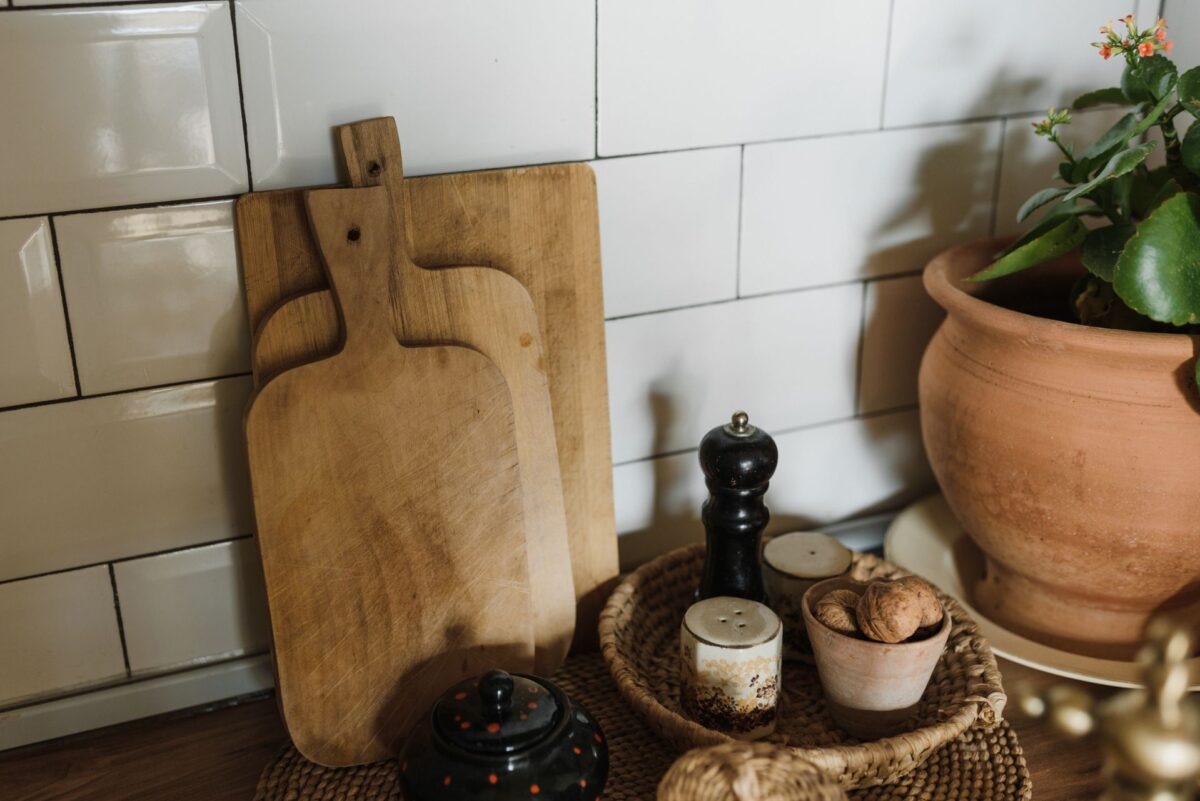
There is no single best wood for every cutting board. The right choice depends on how the board will be used, how resistant you want it to be to dents, how much weight you can handle, and how much maintenance you are willing to do.
For many everyday boards, European beech and hard maple are sensible starting points. Walnut offers a darker appearance and lower indentation resistance than hard maple. Oak can also work well, while olive wood is dense and distinctive but often better suited to smaller boards. These are tendencies, not rankings.
One general check applies to every option: judge the complete board, not the wood name alone. Drying, joints, grain orientation, adhesive and care guidance all affect performance. If a finish is applied, it should be suitable for the board’s intended food-contact use.
What Makes Wood Suitable for a Cutting Board?
Hardness without extremes
A cutting board needs to withstand normal knife marks without feeling unnecessarily unforgiving. The Janka test measures the force needed to press a steel ball into wood, so it describes resistance to indentation. It does not measure how quickly a kitchen knife becomes blunt.
Hardness is therefore one comparison point, not a pass-or-fail score. The finished surface, grain orientation, board condition, cutting technique and knife also affect how the board feels in use.
Grain, moisture and stability
Wood anatomy affects appearance, texture and wear. Beech and hard maple tend to look visually restrained; oak has a more prominent ring pattern; olive wood is often strongly figured. Visible grain should not be turned into a hygiene claim.
Wood also absorbs and releases moisture as its surroundings change. It can swell, shrink or distort, which makes drying, thickness, grain direction and storage important. A practical board should sit flat, have sound joints and come with clear care instructions.
The board as a complete product
Many cutting boards are assembled from several pieces. Joint design and bonding quality matter alongside the raw material. Size matters too: a thick board may feel stable but be awkward to lift and wash, while a slim board may be easier to handle but more prone to movement if poorly designed.
Under EU rules for food-contact materials, products intended to contact food must meet safety requirements. Look for a clear statement of intended use. If a finish is applied, it should be suitable for that use, and the producer should explain whether chopping is permitted and how the surface should be maintained.
Beech, Maple, Walnut, Oak and Olive Wood Compared
Retail labels can be imprecise: “maple,” “oak” and “walnut” may refer to different species, and natural properties vary within a species. This table is a practical comparison, not a product ranking.
| Wood | Typical character | Practical strengths | Trade-offs and buying checks |
|---|---|---|---|
| European beech (Fagus sylvatica) | Firm; pale, restrained appearance | Balanced everyday option when well dried and soundly built | Moisture movement makes careful drying important |
| Hard maple / sugar maple (Acer saccharum) | Firm; pale; high resistance to denting | Hard-wearing surface for regular preparation | “Maple” may mean a different, softer species; verify the name |
| Black walnut (Juglans nigra) | Dark; lower dent resistance than sugar maple | Distinctive appearance; may be lighter at equal dimensions | May mark sooner; total weight depends on board size |
European / English oak (Quercus robur) | Firm; prominent ring pattern | Useful work surface when its intended use is clear | “Oak” is broad; do not infer hygiene from visible grain |
Olive wood (Olea europaea) | Dense, hard and visually distinctive | Characterful option for compact boards when approved for chopping | Can be heavy and very firm; properties vary by cultivar and tree part |
Beech Cutting Boards
European beech (Fagus sylvatica) is a firm hardwood with a pale, relatively even appearance. It is a practical option for an everyday board when you want a surface that does not dominate the kitchen visually.
Beech can move as its moisture content changes, so careful drying and sensible storage matter. Compared with oak, it is usually the quieter-looking choice. Buy on the quality and intended use of the actual board rather than on beech’s reputation alone.
Maple Cutting Boards
“Hard maple” commonly means sugar maple (Acer saccharum), but a board described only as “maple” may use another species. USDA data show substantial differences in side hardness among sugar, red, silver and other maples.
Sugar maple is pale, firm and resistant to denting, which makes it a useful benchmark for an everyday work board. That does not prove it is kinder to knives than every alternative. When comparing maple boards, look for the botanical or common species name rather than relying on the broad label.
Walnut Cutting Boards
Black walnut (Juglans nigra) is valued largely for its dark colour. In USDA clear-wood data, it has lower side hardness and specific gravity than sugar maple. At equal dimensions, a black-walnut board may therefore be lighter and may show dents sooner, although design and thickness determine the actual weight.
Lower hardness is not proof that walnut is “best for knives.” It simply represents a different balance between indentation resistance and surface give.
Oak Cutting Boards
“Oak” is a broad label. European or English oak (Quercus robur), sessile oak (Quercus petraea), American white oak and red-oak species do not have identical properties. Oak’s pronounced ring pattern is a visual characteristic, not evidence that it is unsafe.
For an oak-versus-beech cutting board decision, choose beech if you prefer a pale, more even appearance and oak if you prefer stronger grain. For either option, reject boards with cracks, open joints, an unstable surface or vague care information. If a finish is applied, it should be suitable for the board’s intended food-contact use.
Olive-Wood Cutting Boards
Olive wood (Olea europaea) is dense, hard and visually distinctive. A 2024 study of two Mediterranean cultivars found meaningful differences in several mechanical properties between cultivars and between stem and branch wood. Not every olive-wood board will therefore behave identically.
Its density and hardness can support wear resistance, but may also make a large board heavy and firm under a knife. Some olive-wood pieces are intended mainly for serving, so confirm that the particular item is approved for chopping.
What About Cherry, Acacia, Teak and Bamboo?
Cherry
Black cherry (Prunus serotina) has lower side hardness than sugar maple in USDA data. It may suit someone who likes a warmer colour and accepts that the surface may mark sooner. Check the exact species because “cherry” can be used loosely.
Acacia
“Acacia” is not one dependable specification. The label can refer to different species and changing trade names. Ask for the botanical species and intended food-contact use before comparing it with beech, maple or walnut.
Teak
Do not assume a board is low-maintenance simply because it is labelled teak. Confirm the species, intended use, care instructions and credible sourcing information for the particular product.
Bamboo
Bamboo is not wood in the botanical sense; bamboos belong to the grass family. Bamboo boards are manufactured from processed pieces, so bonding and surface characteristics matter. The word “bamboo” alone does not reveal how hard the finished surface will be or how it will feel under a knife.
Does Edge-Grain or End-Grain Construction Matter?
Yes. On an edge-grain board, the long side of the wood fibres forms most of the cutting surface. On an end-grain board, the fibre ends face upwards. Because wood behaves differently along its longitudinal, radial and tangential directions, this orientation can affect wear and moisture movement.
End-grain boards are often promoted as gentler on knives, but that is not a universal guarantee. They are commonly thicker, heavier and assembled from more individual blocks and glue lines. Edge-grain boards are often simpler and lighter.
Choose according to the complete product: flatness, joint quality, thickness, weight and care requirements. Grain orientation can influence performance, but workmanship and day-to-day handling remain important.
How to Choose the Right Cutting-Board Wood
For durability
Do not simply choose the hardest material. Look for a flat surface, sound joints and enough thickness for the board’s size. A moderately hard, well-built board can be more useful than a harder one with faults.
For knife care
Do not use Janka hardness as a knife-friendliness score. Hard surfaces may feel less forgiving, while softer ones may show marks sooner. Consider the finished surface, its condition, your cutting technique and how often you sharpen your knives.
For weight and handling
Check the dimensions and stated weight. Imagine lifting the board into the sink, turning it over and standing it to dry. A board that is too awkward to clean and dry is a poor everyday choice.
For appearance
Beech and hard maple are generally pale, walnut is dark, oak has stronger ring patterns and olive wood often has high contrast. Colour and figure vary naturally and may change with use and light.
For maintenance
Read the producer’s instructions before buying. For routine washing and drying, see Cookholt’s guide on how to clean a wooden cutting board.
Oiling advice varies. Voedingscentrum advises against oiling wooden cutting boards, while some manufacturers recommend a specified food-contact oil for particular products. Follow the instructions for your board; Cookholt’s separate oiling guide is planned.
Woods and Board Characteristics to Avoid
Avoid a board when the seller cannot identify its material or confirm that it is intended for food preparation. Also avoid:
- Reclaimed, painted, stained or preservative-treated timber with an unknown history.
- Serving pieces that the producer has not approved for chopping.
- Unknown adhesives or coatings, or a finish with no food-contact information if one is applied.
- Cracks, splinters, open glue lines, loose pieces or a rocking surface.
- Products with no usable cleaning and maintenance instructions.
- Absolute claims such as “healthiest,” “toxin-free” or “naturally antibacterial” without relevant evidence.
Frequently Asked Questions
What is the best wood for a cutting board?
There is no universal winner. Beech and hard maple are balanced starting points; walnut, oak and olive wood offer different trade-offs in appearance, hardness and weight. Choose the complete board for your intended use.
Is oak or beech better for a cutting board?
Neither is automatically better. Beech usually looks pale and even, while oak has a stronger grain pattern. Choose between well-made boards with clear intended-use and care information.
Which cutting-board wood is easiest on knives?
Hardness data alone cannot answer this. Grain orientation, surface condition, cutting technique and the knife all affect edge wear and feel.
Is bamboo a type of wood?
No. Bamboo belongs to the grass family, although it is used to make board-like products.
Is the wood species more important than the board’s construction?
Not necessarily. The material influences hardness, density and appearance, but workmanship, grain orientation, thickness and condition can be just as important.
What is the healthiest cutting-board material?
No wood species should be declared the healthiest. As Voedingscentrum guidance indicates, hygiene depends substantially on preventing cross-contamination, washing, thorough drying and replacing boards that are too damaged to clean effectively. Cookholt’s fuller hygiene guide is planned.
A Practical Final Choice
Start with the work the board must do. Beech and hard maple are useful everyday starting points, walnut offers a darker look, oak provides stronger grain, and olive wood can suit compact boards when its weight and hardness are acceptable.
Then assess the product itself: it should be flat, manageable and clearly intended for chopping. Follow its care instructions, and if a finish is applied, make sure it is suitable for the board’s intended food-contact use.
