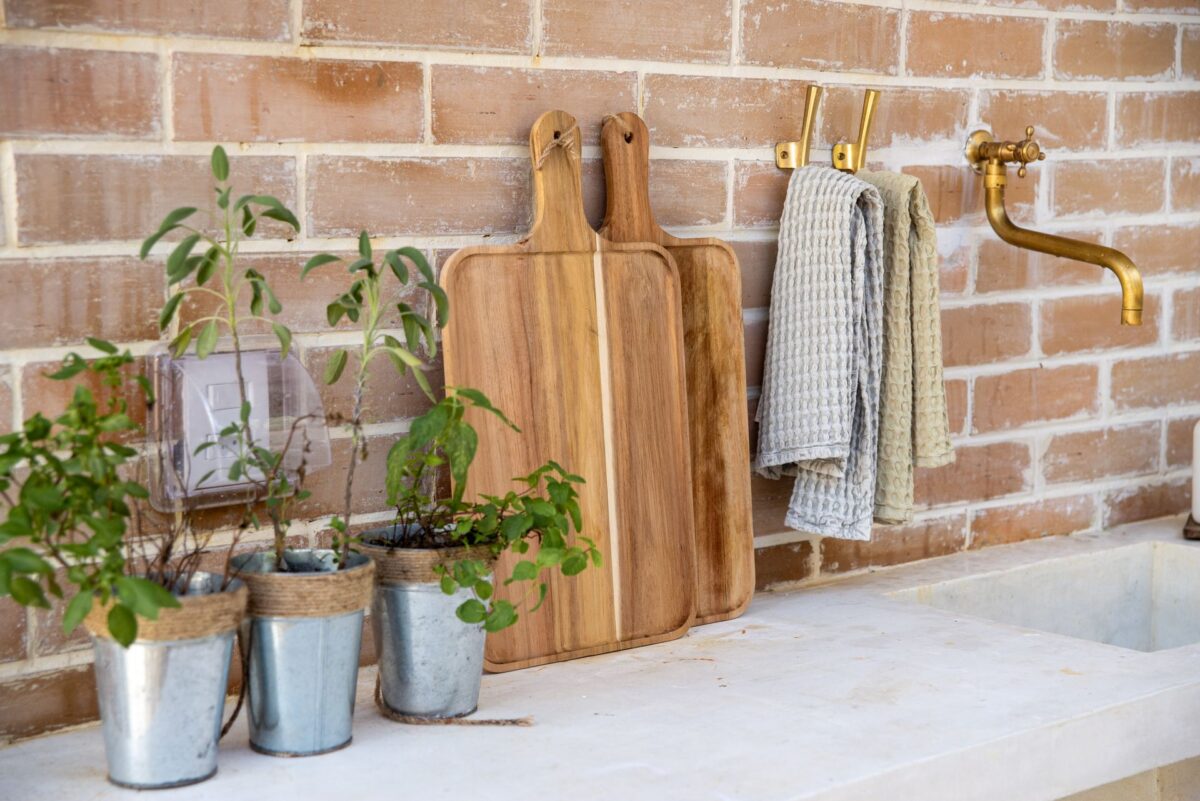
Yes, wooden cutting boards can be hygienic for home use when they are kept clean, allowed to dry completely, maintained in good condition and used in a way that prevents cross-contamination. Wood can carry germs if raw food contaminates it, just as plastic can. The material does not remove the need for careful handling.
The practical questions are whether the board can still be cleaned effectively, whether it dries between uses and whether raw meat, poultry or seafood is kept separate from food that will be eaten without further cooking. A deeply cracked or heavily grooved board of any material is a poor choice because damage makes cleaning more difficult.
Research has found differences in how bacteria can be recovered from wood and plastic under controlled conditions. Those findings are useful, but they do not prove that every wooden board is self-sanitising or automatically safer than plastic in a household kitchen.
What Makes a Wooden Cutting Board Hygienic?
A hygienic board is one that is used and cared for in a way that limits the transfer of harmful microorganisms to food. In practice, that means four things:
- The surface is washed after use, especially after contact with raw animal products.
- The board is allowed to dry completely before storage.
- Raw and ready-to-eat foods are kept separate.
- The board is replaced when cracks, splits or deep grooves make it hard to clean.
Wood species and board construction can affect weight, moisture movement and durability, but they do not replace these habits. If you are choosing a board, Cookholt’s guide to the best wood for cutting boards compares common options without treating any species as inherently the most hygienic.
Wood, Bacteria and What Research Actually Shows
Wood is porous and absorbs moisture. That has led to claims at both extremes: that wooden boards are unsafe because bacteria can enter the surface, or that wood naturally kills bacteria and therefore needs less care. Neither claim is a sound rule for every board and every kitchen.
A 2025 Journal of Food Protection study compared professional sugar-maple and high-density polyethylene cutting boards under laboratory conditions. The researchers applied measured amounts of Escherichia coli and Staphylococcus aureus to the surfaces and then measured the bacteria they could recover over time. Recoverable E. coli on maple fell to the study’s detection limit after two hours, while S. aureus declined more slowly. Bacterial counts recovered from the plastic boards were generally higher in that experiment.
That is evidence about two board materials, two microorganisms and a defined laboratory method. It is not evidence that all bacteria on every wooden board die within two hours, that contaminated wood cannot transfer bacteria to food, or that using wood prevents foodborne illness. A fall in recoverable bacteria may reflect several processes, including cells becoming harder to collect from within the wood; it is not automatically proof that every cell has died.
For the same reason, there is no useful universal answer to “How long do bacteria live on a wooden chopping board?” Survival and recovery vary with the organism, the amount and type of food residue, humidity, temperature, wood, surface wear and the way samples are collected. Laboratory times should not be used as a waiting period instead of washing the board.
Wood Versus Plastic: Which Is More Hygienic?
Neither material is a universal hygiene winner. Both can be used safely, and both can become difficult to clean when badly worn.
The USDA says consumers may use either wood or a non-porous cutting surface for raw meat and poultry, while noting that non-porous surfaces are easier to clean. Dutch Voedingscentrum guidance likewise says different board materials can be used while they remain undamaged, but points out that wooden boards stay damp longer and therefore need to dry thoroughly.
Wood absorbs and releases moisture, so drying and storage deserve particular attention. Plastic does not absorb water in the same way, and some products may tolerate a dishwasher, but repeated knife cuts can create grooves that retain residue and become hard to clean. A smooth, sound board is easier to manage than a heavily scarred one, whatever it is made from.
There are also differences within each category. Wood species, grain orientation, joints and surface treatment vary. Plastic boards use different polymers and thicknesses. Compare the actual product and its care instructions rather than assuming that every wooden or every plastic board behaves identically.
Is It Safe to Cut Raw Meat on a Wooden Board?
Yes. USDA household guidance says that either wood or a non-porous board may be used for raw meat and poultry. A key risk is cross-contamination: juices from raw meat, poultry or seafood can move from the board, knife, hands or worktop to food that will not be cooked afterwards.
Using a dedicated board for raw animal products and another for bread, fruit, vegetables and other ready-to-eat foods makes that separation easier. Both USDA and Voedingscentrum recommend keeping these tasks apart. If one board must be reused, wash it with hot water and washing-up liquid before moving to another food. Wash your hands, and clean the knife, utensils and nearby surfaces that contacted the raw product.
Do not rely on a board’s material, a pause between tasks or an assumed antibacterial effect to make raw-meat contamination harmless. The same separation rule matters whether the board is wood or plastic.
For the full washing and drying method, see Cookholt’s guide on how to clean a wooden cutting board.
Why Are Wooden Boards Sometimes Discouraged?
Advice differs because homes and professional food businesses manage risk in different ways. Commercial kitchens may need documented cleaning and disinfection procedures, dedicated equipment and surfaces that fit local food-safety rules. Household guidance is usually framed around simple actions such as cleaning, separating raw food and replacing worn equipment.
Wood is sometimes discouraged because it is porous, can remain damp longer and may be damaged by cleaning methods designed for some non-porous equipment. A large or heavy board can also be awkward to wash and dry properly. These are practical concerns, not proof that wooden boards are universally banned.
Rules and guidance also vary by jurisdiction. The Food Safety Authority of Ireland, for example, says wooden chopping boards may be used in Irish food businesses if they are kept clean and hygienic, are in sound condition and can be cleaned and, where necessary, disinfected. Its business guidance calls for separate boards for raw and ready-to-eat foods and replacement or re-planing when deep scoring makes a board difficult to clean.
Requirements for food businesses differ by country and setting, so broad claims such as “professional kitchens cannot use wood” are unreliable without naming the jurisdiction and type of operation.
Everyday Habits Matter More Than Marketing Claims
Good hygiene depends on repeatable habits rather than labels such as “naturally antibacterial”, “non-toxic” or “healthiest”.
Wash the board after use, then let it dry fully with air reaching its surfaces. Keep raw animal products separate from ready-to-eat food, and follow the producer’s instructions for cleaning and storage. For step-by-step washing and drying instructions, read Cookholt’s wooden-board cleaning guide.
Inspect the board as it ages. Normal knife marks are expected, but deep grooves, cracks, splits, open joints or areas that remain hard to clean are reasons to replace it. USDA and Voedingscentrum both advise replacing boards that have become excessively worn or difficult to clean.
Oiling does not make a board hygienic by itself, and advice varies between public guidance and individual manufacturers. Follow the instructions supplied with the particular board rather than applying a universal treatment.
Frequently Asked Questions
What is the healthiest material for a cutting board?
There is no well-supported universal “healthiest” material. Hygiene depends substantially on task separation, washing, complete drying and replacing a board that is too damaged to clean. Choose a board intended for food preparation that you can handle and maintain correctly.
What are the downsides of a wooden cutting board?
Wood can stay damp longer than plastic, may warp or crack if mishandled and is often unsuitable for a dishwasher unless the producer explicitly says otherwise. Large boards can also be heavy to wash. Regular inspection and thorough drying are therefore important.
Do I have to wash a wooden cutting board after every use?
Wash it after food preparation and always after contact with raw meat, poultry or seafood. Do not reuse a visibly dirty board or move from raw animal products to ready-to-eat food without washing it first.
The Practical Answer
Wooden cutting boards can be hygienic when they are used carefully, cleaned after use, dried completely and replaced once damage makes effective cleaning difficult. Research does not make wood or plastic a universal winner, so prioritise a sound board and consistent food-safety habits over claims that one material is automatically safer.
